← All women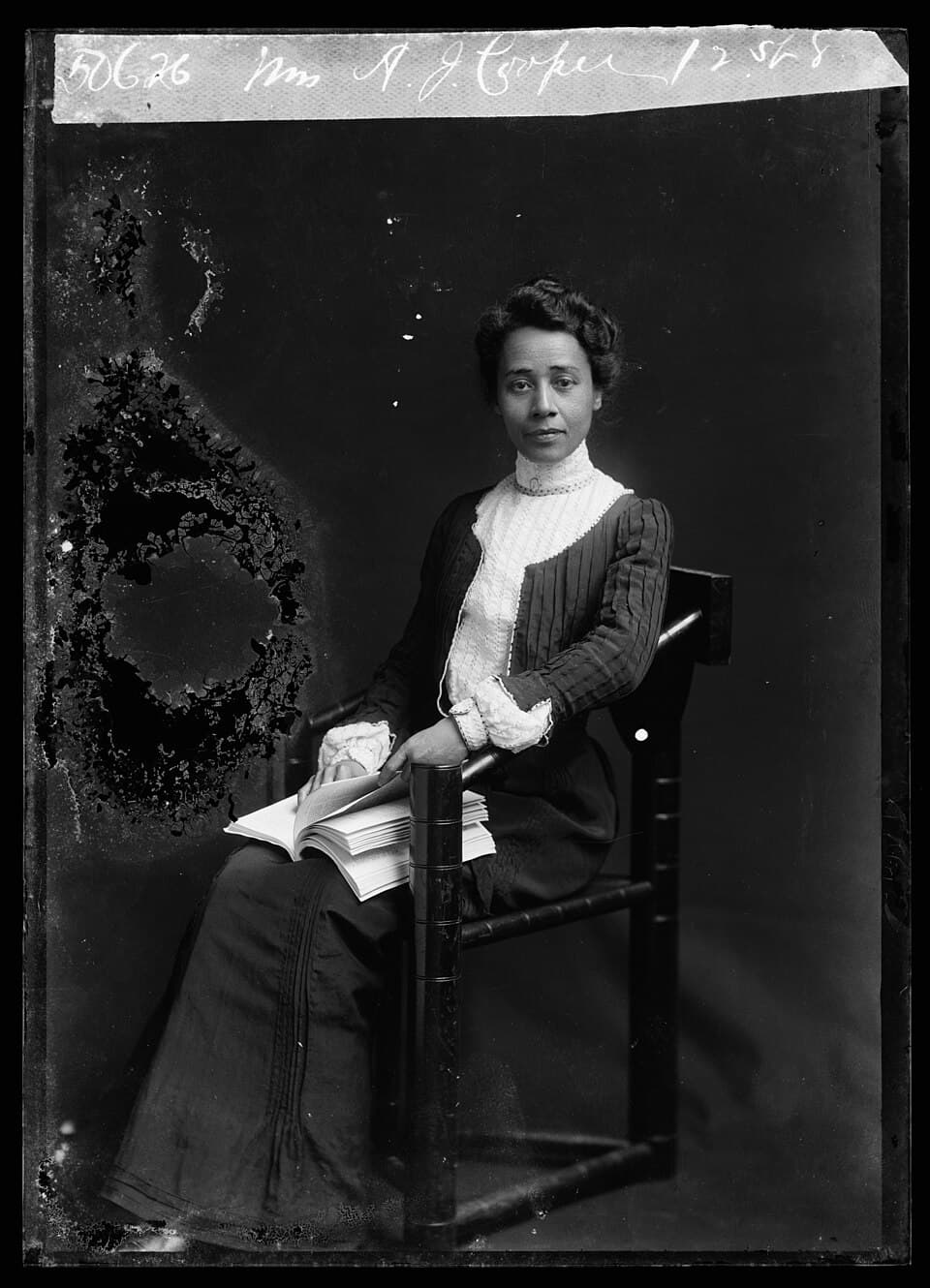
American · Activism · Literature · Science
Anna Julia Cooper
August 10, 1858 – February 27, 1964
Early Life and Background
Anna Julia Haywood Cooper was born into slavery on August 10, 1858, in Raleigh, North Carolina. Her mother, Hannah Stanley Haywood, was an enslaved woman, and her father is widely believed to have been George Washington Haywood, the white man who enslaved her mother's family, though Cooper never publicly confirmed this. Born just a few years before the outbreak of the Civil War, Cooper's earliest years were shaped by the violence and dehumanization of American slavery, followed by the tumultuous promise of Reconstruction.
Emancipation came when Cooper was a young child, opening the door to educational opportunities that had been forbidden to enslaved people. At around age nine, in 1868, she enrolled at St. Augustine's Normal School and Collegiate Institute (now Saint Augustine's University) in Raleigh, an institution established by the Episcopal Church specifically to train Black teachers and clergy in the aftermath of slavery. Cooper displayed extraordinary academic ability from an early age, and she began tutoring other students almost as soon as she herself began studying, foreshadowing her lifelong devotion to teaching.
At St. Augustine's, Cooper had to fight for access to the more rigorous "Gentlemen's Course," which was designed for male students preparing for the ministry, rather than the less demanding curriculum offered to female students. This early experience of gender discrimination within an institution ostensibly devoted to racial uplift became a formative influence on her later feminist writings. It was also at St. Augustine's that she met Rev. George A. C. Cooper, a Episcopal clergyman and one of the school's instructors, whom she married in 1877.
Marriage and Early Career
Anna Haywood married George A. C. Cooper in 1877. Tragically, he died just two years later in 1879, leaving Anna a widow at the age of around 21. She never remarried, a decision that afforded her greater independence to pursue education and career ambitions at a time when marriage typically curtailed women's professional lives.
Following her husband's death, Cooper redoubled her commitment to education. She enrolled at Oberlin College in Ohio, one of the first American colleges to admit both women and Black students. Refusing to be relegated to the "Ladies' Course," she insisted on pursuing the rigorous "Gentlemen's Course" of classical studies, again pushing against gendered expectations. She earned her Bachelor's degree in 1884 and a Master's degree in mathematics in 1887, both from Oberlin, becoming one of the first Black women in America to earn a graduate degree.
Career as Educator and Public Intellectual
After Oberlin, Cooper taught briefly at Wilberforce University and St. Augustine's before moving to Washington, D.C., in 1887 to teach at the M Street High School (later renamed Dunbar High School), the most prestigious Black public high school in the nation at the time. She taught mathematics and science and later became the school's principal in 1902.
As principal, Cooper transformed M Street High School into an institution of remarkable academic rigor, preparing students for admission to elite universities such as Harvard, Yale, and Brown. Her insistence on a classical, college-preparatory curriculum for Black students, rather than the vocational training favored by some contemporaries, put her at odds with the era's dominant educational philosophy associated with Booker T. Washington, aligning her more closely with W.E.B. Du Bois's vision of the "Talented Tenth."
This educational philosophy proved controversial, and in 1906, amid a contentious dispute involving accusations about her conduct and pressure from the school board, Cooper was forced out of her position as principal, though she was later reinstated at the school (though not as principal) in 1910 after teaching for a period at Lincoln University in Missouri.
Major Works: "A Voice from the South"
In 1892, Cooper published her most significant and enduring work, A Voice from the South by a Black Woman of the South. This collection of essays is widely regarded as one of the first articulations of Black feminist thought in American letters. In it, Cooper argued that the progress of the Black race could not be measured by the achievements of Black men alone, famously writing, "Only the BLACK WOMAN can say 'when and where I enter, in the quiet, undisputed dignity of my womanhood, without violence and without suing or special patronage, then and there the whole Negro race enters with me.'"
This work anticipated many of the core ideas later associated with intersectionality, a term coined by legal scholar Kimberlé Crenshaw nearly a century later. Cooper argued that Black women faced compounded discrimination based on both race and gender, and that their liberation was essential to the liberation of the entire race and, indeed, to American democracy itself. The book addressed topics ranging from education and religion to the specific challenges facing Black women in the post-Reconstruction South.
Cooper continued her public advocacy through speeches and writings, including her notable 1893 address at the World's Congress of Representative Women in Chicago, where she spoke alongside other prominent Black women activists like Fannie Barrier Williams. She was also a founding member of organizations dedicated to Black women's advancement, including the Colored Women's League (a precursor to the National Association of Colored Women) and later the Federation of Colored Women's Clubs.
Doctoral Studies and the Sorbonne
Remarkably, Cooper continued to pursue advanced education throughout her life while working full-time. She began doctoral studies at Columbia University in the 1910s but eventually transferred her academic credits to the University of Paris (the Sorbonne) to complete her Ph.D. She defended her dissertation, a historical study titled "L'Attitude de la France à l'égard de l'esclavage pendant la Révolution" (France's Attitude Toward Slavery During the Revolution), on March 23, 1925.
At age 66, Cooper became the fourth African American woman known to earn a doctoral degree, following Georgiana Simpson, Eva Beatrice Dykes, and Sadie Tanner Mossell Alexander, all of whom earned their doctorates in 1921. Cooper's dissertation examined the profound contradiction between the French Revolution's proclaimed ideals of liberty and equality and France's continued practice of slavery in its colonies, a subject with deep personal resonance given her own origins in American slavery.
Later Career: Frelinghuysen University
In addition to her work at M Street/Dunbar High School (from which she formally retired in 1930), Cooper served as president of Frelinghuysen University, an institution in Washington, D.C., dedicated to providing higher education and vocational training to working-class Black adults who had been excluded from traditional universities. She led this institution from 1930 into the 1940s, adapting its mission over the years as the school faced financial and logistical challenges, eventually transforming it into a night school and correspondence program to keep serving its community.
Personal Life
Though widowed young and without biological children, Cooper took on the responsibility of raising five foster children, the grandchildren of her half-brother, after their mother died, further exemplifying her deep commitment to family and community even amid her demanding professional and academic pursuits. She remained active in the Episcopal Church throughout her life, reflecting the faith-based educational tradition in which she was raised at St. Augustine's.
Legacy and Honors
Anna Julia Cooper's intellectual contributions were not fully appreciated in her own lifetime but have grown enormously in stature in the decades since her death. She is now recognized as one of the most important Black feminist theorists in American history, and A Voice from the South is considered a foundational text in African American and women's studies. Scholars have credited her with anticipating intersectional analysis of race, gender, and class decades before such frameworks were formally developed.
Her legacy has been honored in numerous ways:
- The Anna Julia Cooper School and other educational institutions have been named in her honor.
- First Lady Michelle Obama quoted Cooper's famous words about Black womanhood in a 2015 commencement address.
- The U.S. Postal Service issued a commemorative postage stamp honoring Cooper in 2009 as part of its Black Heritage series.
- Her home in Washington, D.C., known as the LeDroit Park residence, has been recognized as a historic site connected to her legacy.
- She has been the subject of numerous academic studies, biographies, and dedicated centers, including the Anna Julia Cooper Center on Gender, Race, and Politics in the South at Wake Forest University.
Death
Anna Julia Cooper died on February 27, 1964, in Washington, D.C., at the age of 105, having lived through slavery, Reconstruction, Jim Crow segregation, both World Wars, and into the early years of the modern Civil Rights Movement. She was buried in the City Cemetery in Raleigh, North Carolina, the city of her birth. Her extraordinary life journey—from an enslaved child to one of the foremost Black intellectuals of her era—stands as a testament to resilience, scholarship, and an unwavering commitment to justice and education.
Dated achievements
4 indexed.
- Aug101858Activism
Birth of Anna Julia Cooper in Raleigh, North Carolina
Born into slavery in Raleigh, North Carolina, to an enslaved mother, Hannah Stanley Haywood.
View details Anna J. Cooper - Wikipedia - Mar011893Activism
Delivers landmark address 'The Intellectual Progress of the Colored Women in the United States Since Emancipation'
Cooper delivered a major address at the World's Congress of Representative Women in Chicago, championing Black women's intellectual advancement.