← All women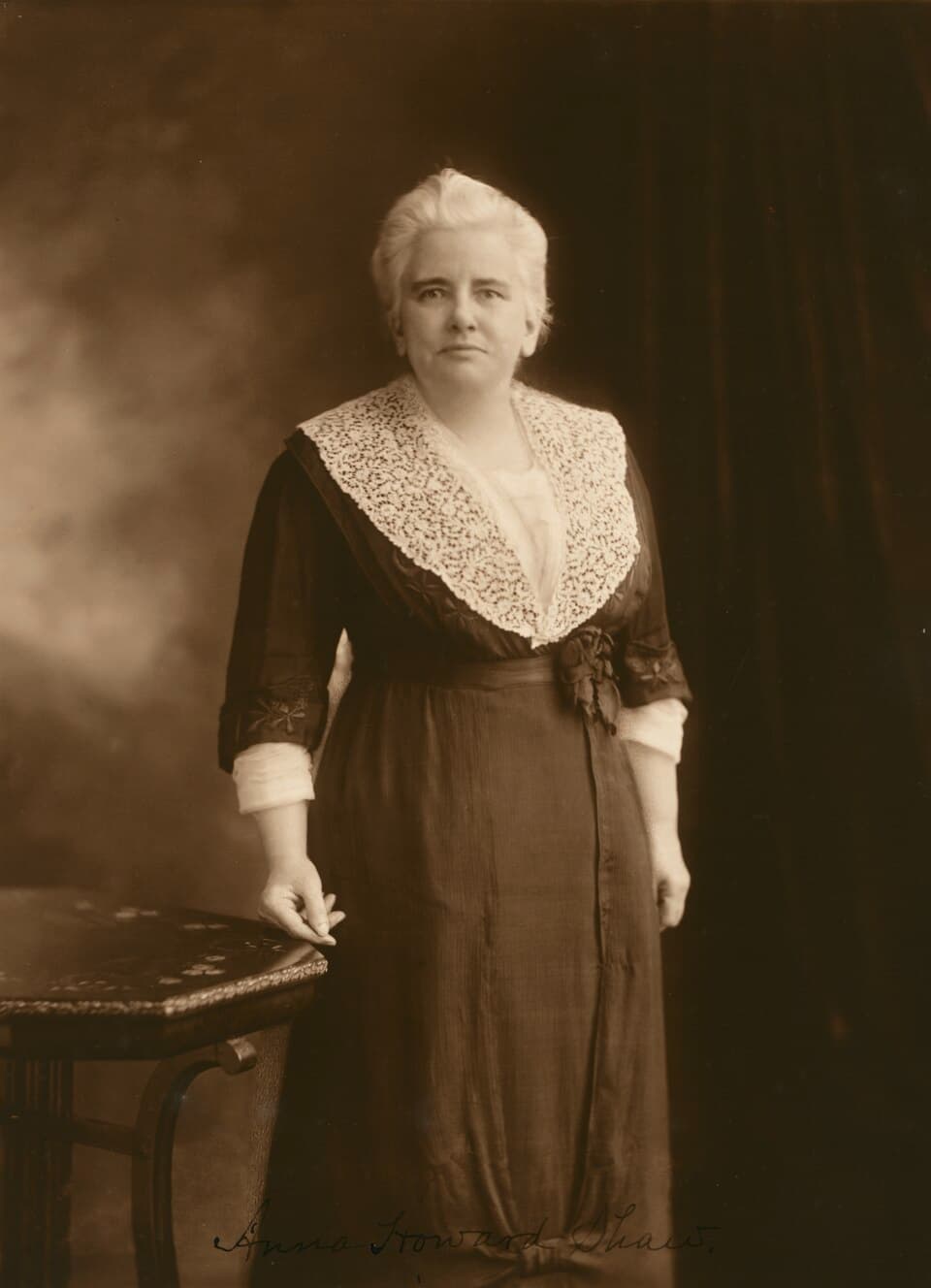
American, British (birth) · Activism · Medicine · Politics
Anna Howard Shaw
February 14, 1847 – July 2, 1919
Early Life and Background
Anna Howard Shaw was born on February 14, 1847, in Newcastle-upon-Tyne, England, the sixth of seven children born to Thomas Shaw and Nicolas Stott Shaw. In 1851, when Anna was four years old, her family emigrated to the United States, first settling in Lawrence, Massachusetts. Her father, an idealistic but often impractical man, was drawn to utopian causes and eventually decided to move the family to the wilderness of Michigan in 1859, staking a claim in what was then a nearly uninhabited forest near Big Rapids.
The Michigan homestead years were formative and harsh. Thomas Shaw was frequently absent—first pursuing other ventures, later serving in the Union Army during the Civil War—leaving Anna's mother, a woman of refined sensibilities from a genteel background, to manage the frontier household with her children. The family endured poverty, isolation, and grueling physical labor. Anna's mother suffered from severe depression exacerbated by the harshness of pioneer life, and young Anna took on adult responsibilities early, including building the family's log cabin, farming, and caring for younger siblings.
Despite minimal formal schooling, Anna was intellectually voracious. She taught herself to read fluently and displayed a natural gift for oratory even as a child, reportedly practicing sermons and speeches to the trees in the forest. At age fifteen, she secured a position as a schoolteacher, one of few respectable professions open to women at the time, earning a wage far lower than her male counterparts—an early, formative encounter with gender-based economic injustice that would shape her later activism.
Education and Religious Calling
Shaw's path toward ministry began when she moved to live with her married sister in Big Rapids, Michigan, where she was mentored by local clergy who recognized her extraordinary speaking talent. She preached her first sermon in 1870, and her eloquence quickly attracted attention and controversy in equal measure, as women preachers were a rarity and frequently faced fierce opposition.
Determined to pursue formal theological training, Shaw enrolled at Albion College in Michigan and later at Boston University's School of Theology, entering in 1876. She was the only woman in her class, and the experience was one of profound hardship: she was denied financial support offered to male students, endured social ostracism, and lived in near-poverty, at one point subsisting on crackers and canned goods. She graduated in 1878.
On June 10, 1878, Shaw was ordained by the Methodist Protestant Church, becoming one of the first women in the United States to be formally ordained as a minister in a mainstream Protestant denomination. She went on to serve as pastor of churches in East Dennis and Wareham, Massachusetts, for several years, becoming known for sermons that combined spiritual conviction with an emerging social consciousness about poverty, temperance, and women's rights.
Medical Training and Dual Career
Not content with her achievements in ministry, Shaw pursued a second demanding course of study: medicine. While continuing her pastoral duties, she enrolled at Boston University School of Medicine and earned her medical degree in 1886. She practiced briefly, gaining firsthand insight into the social and physical toll that poverty, lack of legal rights, and alcoholism took on women and families—experiences that reinforced her commitment to reform movements, particularly temperance and suffrage.
Her combined credentials as ordained minister and licensed physician were virtually unmatched among women of her era and lent her exceptional authority and credibility as a public reform advocate, allowing her to speak with moral, scientific, and pastoral legitimacy on the social issues of the day.
Entry into Suffrage and Temperance Activism
Shaw's activism formally began through the temperance movement. She became a lecturer for the Massachusetts Woman's Christian Temperance Union (WCTU), where she first honed her skills as a persuasive public speaker on a national stage. Her work with the WCTU convinced her that women's suffrage was a necessary precondition for meaningful social reform, since women lacked any political leverage to combat social ills like alcoholism, domestic abuse, and economic exploitation without the vote.
She soon aligned herself with the leading suffragists of the era, including Susan B. Anthony, who became a close friend, mentor, and lifelong influence. Shaw was elected president of the Massachusetts Woman Suffrage Association in 1888 and began delivering speeches across the country on behalf of the National American Woman Suffrage Association (NAWSA), quickly earning a reputation as one of the most electrifying orators of the movement—admirers and critics alike remarked on her ability to move audiences of thousands with wit, moral force, and rhetorical precision.
Leadership of NAWSA
Shaw's stature within the suffrage movement culminated in her election as president of NAWSA in 1904, a position she held until 1915. Her presidency spanned a difficult period during which the organization struggled with internal strategic disagreements, funding shortages, and the challenge of sustaining momentum after decades of activism without full victory. Shaw provided steady, if sometimes contested, leadership, emphasizing state-by-state referendum campaigns and extensive speaking tours.
She traveled tirelessly throughout her presidency, delivering an estimated tens of thousands of speeches over her career, often to hostile or skeptical crowds, and helped keep the suffrage cause in the national spotlight during the years leading up to the movement's final successful push. She organized major rallies and demonstrations, including symbolic Independence Day events highlighting the contradiction between American ideals of liberty and women's disenfranchisement.
Shaw resigned the NAWSA presidency in 1915, and was succeeded by Carrie Chapman Catt, who would lead the organization through the final ratification campaign for the Nineteenth Amendment.
World War I Service and Honors
During World War I, Shaw redirected her formidable organizational energy toward the war effort, chairing the Woman's Committee of the Council of National Defense, which coordinated women's contributions to the war effort across the United States, including labor mobilization, resource conservation, and morale campaigns. For this service, she was awarded the Distinguished Service Medal, becoming the first woman to receive this decoration—a striking recognition given her decades of being dismissed by many as merely an agitator.
In the final months of her life, Shaw campaigned for American involvement in the League of Nations, believing that international cooperation was essential to preventing future wars, extending her reform vision beyond domestic suffrage to global peace.
Personal Life
Shaw never married and had no children, a common circumstance among prominent first-generation professional women of her era who often faced a stark choice between career and conventional domestic life. She maintained a close, lifelong companionship with Lucy E. Anthony, niece of Susan B. Anthony, with whom she lived for over three decades in a devoted partnership that provided personal support throughout her demanding public career.
Her friendship with Susan B. Anthony was a defining relationship of her adult life; Anthony mentored Shaw and designated her as a chosen successor within the suffrage movement's leadership, a torch Shaw carried forward for decades after Anthony's death in 1906.
Death and Legacy
Anna Howard Shaw died on July 2, 1919, at her home in Moylan, Pennsylvania, at the age of 72, just over a year before the ratification of the Nineteenth Amendment on August 18, 1920—the culmination of the cause to which she had devoted most of her adult life. She did not live to cast a legal ballot in a national election.
Shaw's legacy is commemorated through numerous institutions and honors, including the Anna Howard Shaw Center at Boston University School of Theology, which continues to support women in ministry and theological education. She was inducted into the National Women's Hall of Fame and the Michigan Women's Hall of Fame in recognition of her multifaceted contributions as minister, physician, orator, and reformer.
Her life exemplifies the extraordinary determination required of nineteenth-century women who sought to break into male-dominated professions and civic life. Overcoming poverty, minimal formal education, and pervasive discrimination, Shaw became a minister, a physician, and one of the most influential leaders of the American women's suffrage movement, leaving an enduring legacy in the fight for gender equality and civic participation in the United States.
Dated achievements
4 indexed.
- Feb141847Activism
Birth of Anna Howard Shaw
Anna Howard Shaw was born in Newcastle-upon-Tyne, England, on February 14, 1847, later emigrating with her family to the United States.
View details Anna Howard Shaw - Wikipedia - Jun101878Activism
Ordained as Methodist Minister
Shaw was ordained by the Methodist Protestant Church, becoming one of the first women ordained as a minister in the United States.