← All women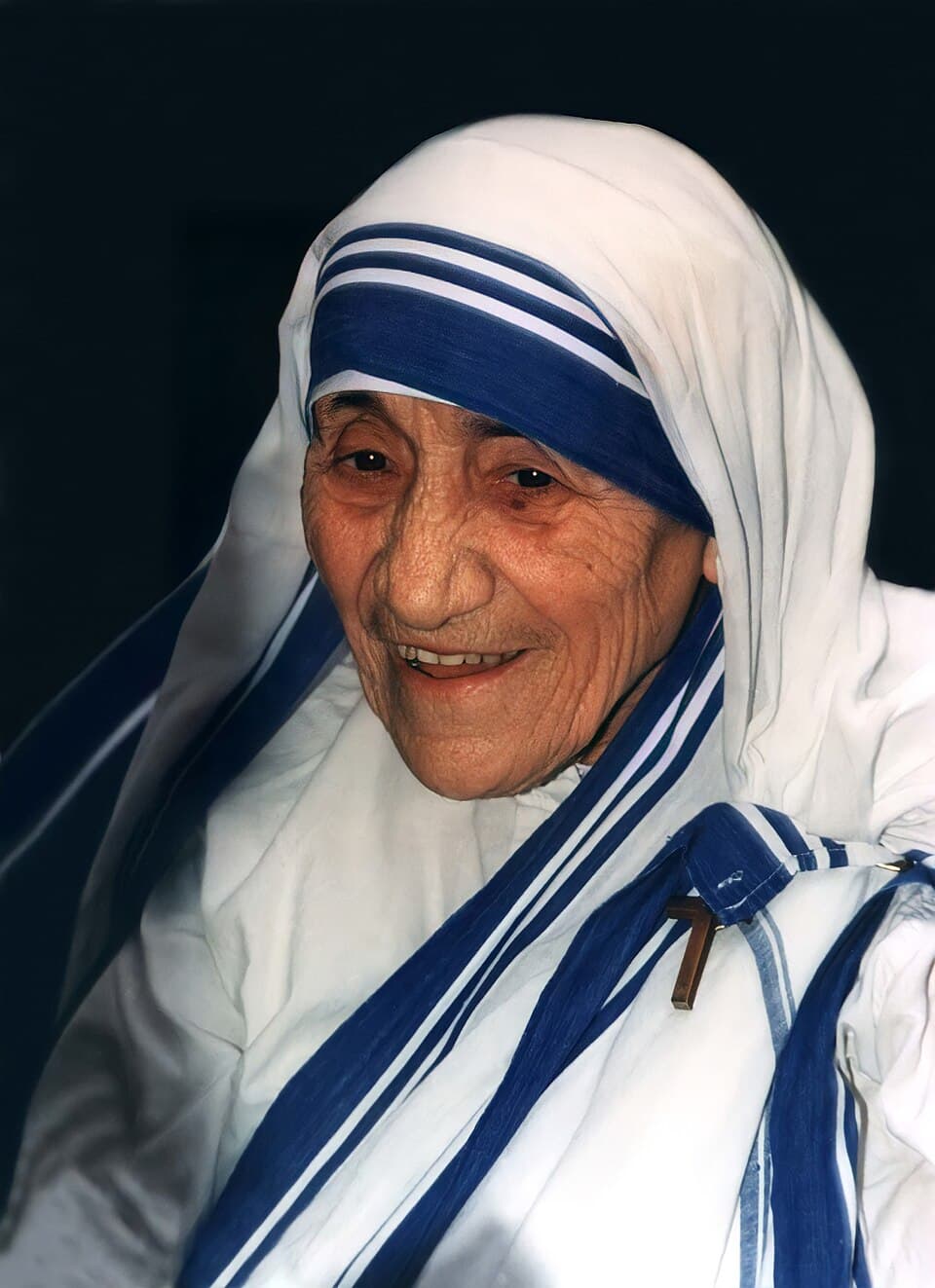
Albanian · Activism · Medicine
Anjezë Gonxhe Bojaxhiu
August 26, 1910 – September 5, 1997
Early Life and Background
Anjezë Gonxhe Bojaxhiu, famously known as Mother Teresa, was born on August 26, 1910, in Skopje, then part of the Ottoman Empire and now in North Macedonia. She was the youngest child of a Kosovar Albanian family. Her father, Ndoke Bojaxhiu, was a businessman and church councillor, while her mother, Dranafile Bojaxhiu, was deeply religious and engaged in local charity. From a young age, Anjezë was influenced by her mother’s compassion and dedication to helping others, which laid the foundation for her life’s work.
Her initial education took place at a convent-run school, and by age 12, she felt a calling to religious life. At 18, she joined the Sisters of Loreto in Ireland, where she learned English and began her spiritual training. It was during this time that she took the name Teresa, after Saint Thérèse of Lisieux.
Career Beginnings and Development
In 1929, after completing her training, Mother Teresa was sent to India, where she began work as a teacher at the Loreto convent school in Entally, Kolkata. She took her solemn vows in 1937 and became "Mother Teresa." Despite the comfort of her position, she was deeply moved by the poverty surrounding her in Kolkata.
In 1946, during a train ride to Darjeeling, she experienced what she later called "the call within the call," a divine inspiration to abandon teaching and to work among the poorest in the slums of Kolkata. Two years later, with the Vatican’s permission, she left the Loreto order to pursue this mission.
Founding of the Missionaries of Charity
By 1948, Mother Teresa had Indian citizenship and began her work by opening a school in Motijhil. With minimal resources but unwavering dedication, she established the Missionaries of Charity in 1950, a religious congregation tasked with caring for the "hungry, the naked, the homeless, the crippled, the blind, the lepers, all those who feel unwanted and unloved." The congregation rapidly expanded globally, serving the needy across continents.
Her first hospice, named Kalighat Home for the Dying, opened in 1952, where she provided dying people with medical care and dignity. Over the years, the Missionaries of Charity established facilities worldwide, including orphanages, homes for people with HIV/AIDS, and schools.
Awards and Recognition
Mother Teresa's work received international accolades. She was awarded the Nobel Peace Prize in 1979, recognized for her tireless efforts for the "struggling humanity and her contribution to peace by addressing poverty and distress." She refused the usual Nobel ceremonial banquet, asking that the $192,000 prize be given to the poor in India.
Her honors include India’s Bharat Ratna in 1980, and over 120 other awards and honors. Despite criticism from some regarding her methods and ideology, her humanitarian work remained widely celebrated.
Legacy and Historical Impact
Mother Teresa's legacy is embodied in the continuation of the Missionaries of Charity's work, present in over 130 countries. She became a symbol of compassion and selfless service, inspiring countless individuals to volunteer and engage in charitable work across the globe.
Her life and work have also been the subject of scholarly debate, focusing on her views on suffering, medicine, and her outspoken criticism of abortion. Despite controversies, her canonization as a saint in 2016 by Pope Francis underscores her enduring impact on global charity and faith-driven service.
Later Life and Death
In her later years, Mother Teresa continued to lead her congregation while enduring increasing health challenges. She suffered from heart, lung, and kidneys’ ailments but remained active until her death. On September 5, 1997, Mother Teresa passed away in Kolkata at the age of 87. She was given a state funeral by the Indian government, honoring her tireless dedication to the poor.
Dated achievements
2 indexed.
- Aug261910Activism
Birth of Anjezë Gonxhe Bojaxhiu
Mother Teresa was born on August 26, 1910, in Skopje, then part of the Ottoman Empire.
View details Wikipedia: Mother Teresa - Oct171979Activism
Awarded the Nobel Peace Prize
Mother Teresa received the Nobel Peace Prize on October 17, 1979, recognizing her humanitarian work.