← All women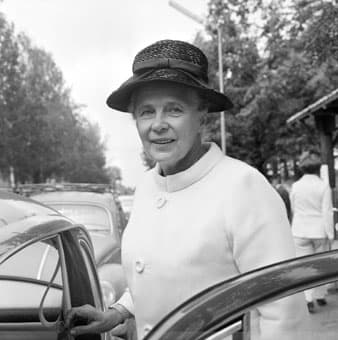
Swedish · Politics · Activism · Literature
Alva Myrdal
January 31, 1902 – February 1, 1986
Early Life and Education
Alva Reimer Myrdal was born on January 31, 1902, in Uppsala, Sweden, the eldest of five children of Albert Reimer, a building contractor active in local politics and the temperance movement, and Lova Reimer. Growing up in a household attuned to civic engagement and reform, Alva developed an early interest in social questions. She attended school in Stockholm, where her family later moved, and pursued higher education at Stockholm University College, an unusual path for a woman of her generation, studying pedagogy, sociology, and psychology.
Her intellectual formation was further shaped by international exposure: she studied briefly in England and the United States, encountering progressive educational theories and social scientific approaches to public policy that would inform her lifelong belief that rigorous social science could and should guide government action for human welfare.
Marriage to Gunnar Myrdal and Early Career
In 1924, Alva married Gunnar Myrdal, a brilliant young economist who would later win the Nobel Memorial Prize in Economic Sciences in 1974. Their partnership became one of the most intellectually productive marriages of the twentieth century. The couple traveled together, studying social and economic conditions in the United States and Europe, and collaborated extensively on research and writing, blending Alva's sociological and psychological expertise with Gunnar's economic analysis.
In 1934, the couple published their most influential joint work, Kris i befolkningsfrågan (Crisis in the Population Question), which addressed Sweden's declining birth rate not through coercive pronatalist policy but through progressive social reforms: subsidized housing, maternal healthcare, childcare, and family allowances. The book was a sensation in Sweden, providing the intellectual foundation for the modern Swedish welfare state (folkhemmet) and establishing Alva as a leading voice in social policy, particularly regarding women's roles in both family life and the workforce. She argued that women should not be forced to choose between careers and motherhood, advocating instead for state support enabling both.
Institution Building and International Work
Alva Myrdal's career expanded rapidly through the 1930s and 1940s. She directed the Training College for Preschool Teachers in Stockholm (Socialpedagogiska Seminariet) from 1936 to 1948, applying progressive educational theories in practice and training a generation of Swedish educators. During this period she also became involved with the Swedish Social Democratic Party, aligning her academic work with concrete political reform.
Her reputation as a skilled administrator and thinker led to her appointment to a series of increasingly prominent international roles. In 1949, she became head of the Department of Social Sciences at UNESCO in Paris, the first woman to hold such a senior position at the organization. She later served as director of the United Nations Department of Social Affairs from 1950 to 1955, overseeing international social policy initiatives during the difficult early Cold War years.
From 1955 to 1961, Myrdal served as Swedish ambassador to India, Burma (Myanmar), Ceylon (Sri Lanka), and Nepal, becoming one of the first women in the world to hold a senior ambassadorial post. Her time in India deepened her engagement with the developing world's challenges around poverty, population growth, and disarmament, and brought her into contact with leaders such as Jawaharlal Nehru.
Disarmament Diplomacy and Political Leadership
Myrdal's most historically significant contributions came in the arena of nuclear disarmament. In 1962, she became Sweden's chief delegate to the Geneva Disarmament Conference (the Eighteen Nation Committee on Disarmament), where she represented Sweden's non-aligned position amid Cold War tensions between the United States and Soviet Union. She pushed relentlessly for a comprehensive nuclear test ban, non-proliferation measures, and reductions in nuclear stockpiles, often clashing diplomatically with representatives of both superpowers who she believed prioritized strategic advantage over genuine disarmament.
In 1966, she was appointed to the Swedish cabinet as Minister without Portfolio (later Minister for Disarmament) under Prime Minister Tage Erlander and later Olof Palme, a position she held until 1973. In this role, she was a forceful advocate for Sweden's independent foreign policy and a critic of great-power nuclear posturing, publishing numerous articles and speeches challenging the logic of deterrence theory.
Her 1976 book The Game of Disarmament: How the United States and Russia Run the Arms Race was a scathing critique of the superpowers' disarmament rhetoric versus their actual behavior, arguing that both nations were more interested in maintaining strategic dominance than achieving real reductions in nuclear arsenals. The book received international acclaim and cemented her reputation as one of the era's most incisive critics of the nuclear arms race.
The Nobel Peace Prize and Later Honors
In 1982, Alva Myrdal was awarded the Nobel Peace Prize jointly with Mexican diplomat Alfonso García Robles "for their work on disarmament negotiations in the United Nations." The award recognized decades of sustained advocacy and diplomatic effort toward nuclear non-proliferation and arms control, at a time when Cold War tensions had once again escalated. Myrdal remains the only Swedish woman to have won a Nobel Prize in the Peace category, and one of relatively few women Nobel Peace laureates of the twentieth century.
Beyond the Nobel Prize, Myrdal received numerous other honors throughout her career, including honorary doctorates from several universities and various peace and humanitarian awards recognizing her decades of work in social policy and disarmament advocacy.
Personal Life
Alva and Gunnar Myrdal had three children: Jan, who became a writer; Sissela, who became a philosopher known as Sissela Bok after marrying Harvard president Derek Bok; and Kaj, who became a sociologist. The Myrdal household was intellectually vibrant but also fraught with tension, as both parents pursued demanding, high-profile careers and spent significant time apart due to international postings. Alva's relationship with her children, particularly her daughter Sissela, was complex, with later reflections acknowledging the difficulties of balancing personal ambition with family life — ironically the very tension her earlier work on social policy sought to alleviate for other women.
Legacy
Alva Myrdal's influence spans social policy, feminist theory, international diplomacy, and the global movement against nuclear weapons. Her early work with Gunnar Myrdal laid crucial intellectual groundwork for the Swedish welfare state model, which became internationally influential as an example of social democratic governance. Her pioneering role as a woman in high diplomacy — as ambassador, UN official, and cabinet minister — helped open doors for women in international affairs during an era when such positions were almost exclusively held by men.
Her disarmament advocacy, culminating in the Nobel Peace Prize, remains a touchstone for scholars and activists working on nuclear non-proliferation. Institutions and prizes have been established in her honor, and her extensive writings continue to be studied in the fields of sociology, political science, and international relations. She died on February 1, 1986, in Stockholm, leaving behind a legacy as one of the twentieth century's most consequential women in public life — a rare figure who shaped policy at both the national and international levels across multiple, interconnected domains of social welfare and global peace.
Dated achievements
3 indexed.
- Jan311902Science
Born in Uppsala, Sweden
Alva Myrdal was born Alva Reimer on January 31, 1902, in Uppsala, Sweden.
View details Alva Myrdal - Wikipedia - Dec101982Science
Awarded the Nobel Peace Prize
Alva Myrdal received the 1982 Nobel Peace Prize, shared with Alfonso García Robles, for disarmament negotiation work.
View details