← All women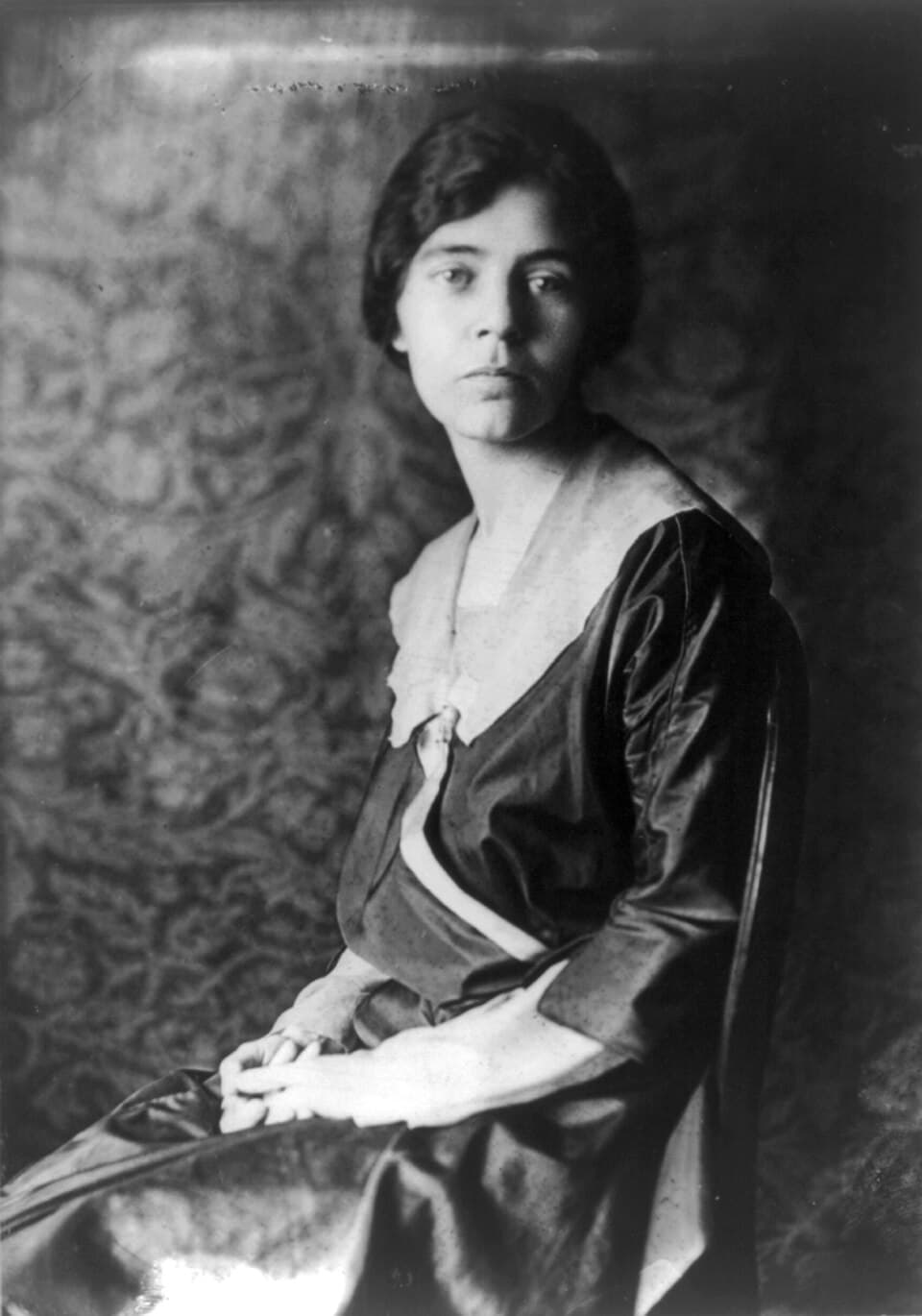
American · Activism · Politics
Alice Paul
January 11, 1885 – July 9, 1977
Early Life and Education
Alice Stokes Paul was born on January 11, 1885, at Paulsdale, her family's farm in Mount Laurel, New Jersey. She was the eldest of four children born to William Mickle Paul I, a farmer and businessman, and Tacie Parry Paul. The family were devout Hicksite Quakers who traced their ancestry to prominent early colonial figures, including William Penn, founder of Pennsylvania. The Quaker faith's core belief in gender equality — that men and women were spiritually equal and equally capable of moral and civic leadership — profoundly shaped Paul's worldview from childhood. Her mother, a member of the National American Woman Suffrage Association (NAWSA), frequently brought young Alice to suffrage meetings.
Paul was an exceptional student. She graduated from Swarthmore College, a Quaker institution co-founded by her grandfather, in 1905 with a degree in biology. She went on to earn a master's degree in sociology from the University of Pennsylvania in 1907, and later a Ph.D. in sociology from the same institution in 1912, with a dissertation titled "The Legal Position of Women in Pennsylvania." Remarkably, she also later earned three law degrees — an LL.B. (1922), a Master of Laws (1927), and a Doctor of Civil Laws (1928) — all from American University, reflecting her lifelong commitment to using legal expertise to advance women's rights.
Formative Years in England
Between 1907 and 1910, Paul studied and worked in England, where she became deeply involved with the British suffragette movement led by Emmeline and Christabel Pankhurst's Women's Social and Political Union (WSPU). This experience was transformative. Paul participated in militant WSPU tactics, including protests, window-smashing, and hunger strikes, and was arrested and imprisoned multiple times in England. She endured force-feeding after going on hunger strike — a brutal experience that foreshadowed what she would later suffer in the United States. These years taught her the power of dramatic, confrontational, media-savvy protest, in stark contrast to the more genteel lobbying approach favored by mainstream American suffragists.
Return to America and the Suffrage Campaign
Paul returned to the United States in 1910 and quickly rose within NAWSA, taking charge of its Congressional Committee in Washington, D.C. She organized the massive Woman Suffrage Procession on March 3, 1913 — the day before Woodrow Wilson's presidential inauguration — which drew thousands of marchers and spectators to Pennsylvania Avenue and turned violent when hostile crowds attacked participants while police failed to intervene. The event generated enormous national publicity and highlighted the urgency of the suffrage cause.
Frustrated with NAWSA's incremental, state-by-state strategy, Paul and colleague Lucy Burns broke away in 1913 to found the Congressional Union for Woman Suffrage, which became the National Woman's Party (NWP) in 1916. The NWP focused exclusively on securing a federal constitutional amendment guaranteeing women's suffrage nationwide, employing aggressive tactics inspired by the British suffragettes.
The Silent Sentinels and Imprisonment
The NWP's most famous campaign began on January 10, 1917, when Paul organized the "Silent Sentinels" — the first group ever to picket the White House. For over two years, women stood at the White House gates holding banners demanding suffrage, enduring winter weather, public hostility, and eventually arrest, particularly after the U.S. entered World War I in April 1917, when banners questioning Wilson's commitment to democracy abroad while denying it to women at home were deemed unpatriotic.
Paul and dozens of other picketers were arrested on charges of obstructing traffic and imprisoned, most notoriously at the Occoquan Workhouse in Virginia. Conditions were harsh; on the "Night of Terror" (November 14, 1917), guards brutally beat and abused imprisoned suffragists. Paul herself was held in solitary confinement and transferred to a psychiatric ward, where she undertook a hunger strike and was subjected to forced feeding — a painful and dangerous procedure involving tubes forced down the throat. Public outrage over these abuses, once reported in the press, generated a wave of sympathy that significantly increased political pressure on Wilson and Congress.
Achieving the Nineteenth Amendment
The sustained pressure from the NWP's protests, combined with NAWSA's political lobbying under Carrie Chapman Catt, contributed to Wilson's eventual public support for a suffrage amendment. Congress passed the Nineteenth Amendment in June 1919, and it was ratified by the requisite thirty-six states on August 18, 1920, when Tennessee cast the deciding vote. The amendment guaranteed that the right to vote could not be denied on account of sex, enfranchising millions of American women.
The Equal Rights Amendment and Later Activism
Rather than retiring after suffrage was won, Paul immediately turned to the next phase of her life's mission: full legal equality for women. She earned her law degrees specifically to draft effective legislation. On July 9, 1923, at a gathering commemorating the seventy-fifth anniversary of the Seneca Falls Convention, Paul introduced the original text of the Equal Rights Amendment, which would be introduced in every session of Congress for decades thereafter.
Paul also worked internationally, helping to found the World Woman's Party in 1938 and successfully lobbying for the inclusion of sex equality language in the United Nations Charter (1945) and the Universal Declaration of Human Rights (1948). In the United States, she was instrumental in ensuring that "sex" was included as a protected category in Title VII of the Civil Rights Act of 1964, preventing employment discrimination against women — a lesser-known but hugely consequential achievement often overshadowed by her suffrage work.
Personal Life
Alice Paul never married and had no children, a choice she made deliberately, believing that marriage and family obligations of the era would compromise her ability to dedicate herself fully to political activism. She lived for periods in Washington, D.C., in a NWP-owned townhouse near the Capitol, and maintained close, lifelong friendships and working relationships with fellow activists, including Lucy Burns. Her Quaker faith remained a guiding influence throughout her life, informing both her moral conviction and her disciplined, ascetic lifestyle.
Later Life, Death, and Legacy
Paul continued advocating for the ERA into her final years, witnessing its passage by Congress in 1972 and the beginning of a fraught ratification battle among the states. She died on July 9, 1977, at the Greenleaf Extension nursing home in Moorestown, New Jersey, at age 92, following a stroke. She did not live to see the ERA's ratification deadline expire in 1982, when it fell three states short of the required thirty-eight.
Alice Paul is remembered as one of the most consequential, strategically brilliant, and uncompromising leaders of the American women's rights movement. Her innovative use of nonviolent civil disobedience — picketing, hunger strikes, and dramatic public spectacle — set precedents later adopted by the civil rights movement and other social justice campaigns throughout the twentieth century. Her family home, Paulsdale, was designated a National Historic Landmark in 1991 and today houses the Alice Paul Institute, an organization dedicated to developing leadership skills in girls and young women. Numerous schools, buildings, and public spaces across the United States bear her name, and she is widely regarded, alongside Susan B. Anthony and Elizabeth Cady Stanton, as one of the towering figures of American feminism.
Dated achievements
1 indexed.
- Jan111885Activism
Alice Paul Born
Alice Paul was born on January 11, 1885, in Mount Laurel, New Jersey.
View details Alice Paul Biography - Women's History