← All women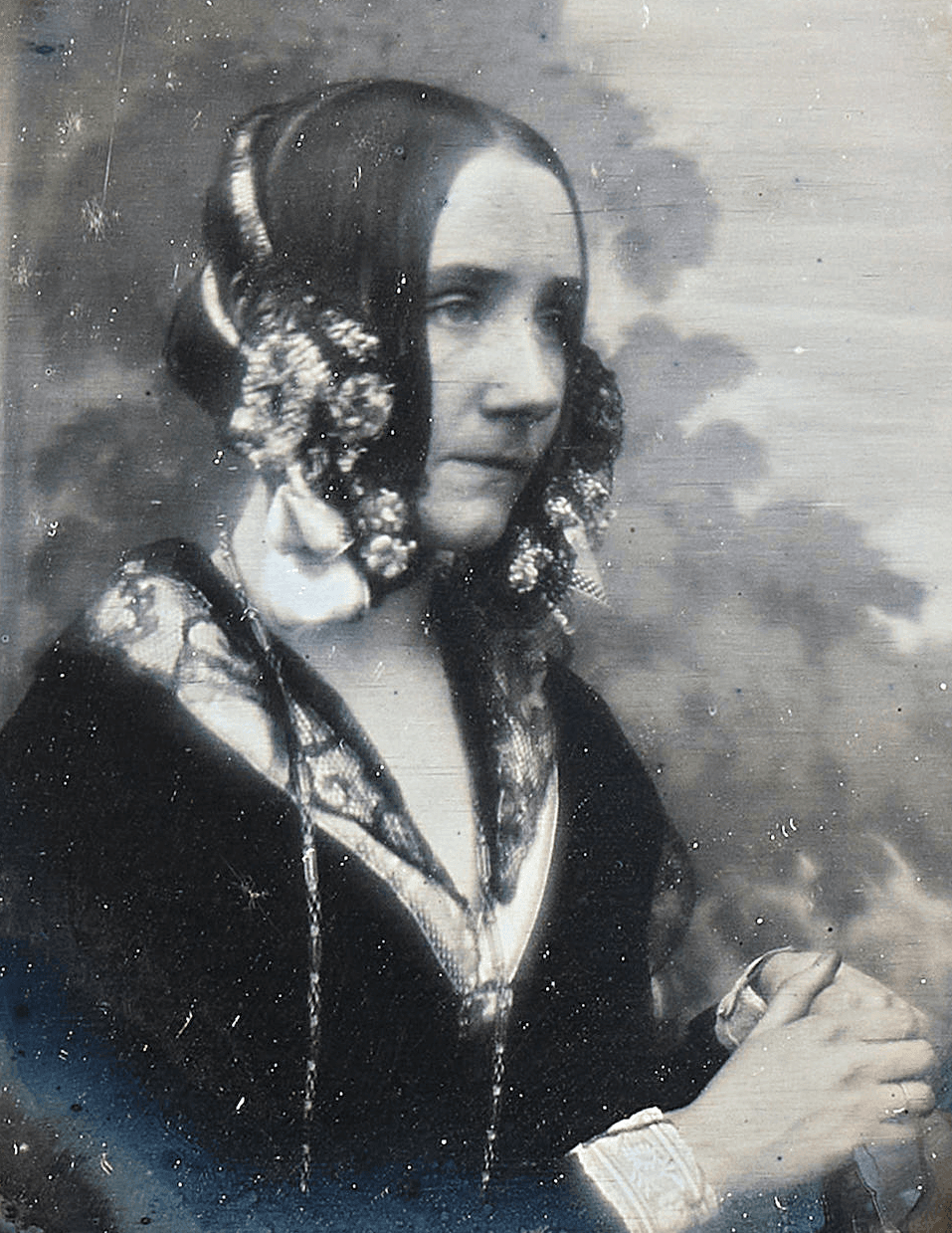
British · Science
Augusta Ada King, Countess of Lovelace (née Byron)
December 10, 1815 – November 27, 1852
Early Life and Background
Augusta Ada Byron was born on 10 December 1815 in London, England, the only legitimate child of the poet Lord George Gordon Byron and Anne Isabella "Annabella" Milbanke, a mathematically educated noblewoman. Byron had hoped for a son and expressed disappointment at Ada's birth, but the marriage collapsed within weeks regardless, amid rumors of Byron's infidelities, debts, and erratic behavior. Lady Byron separated from her husband when Ada was only five weeks old, and Byron left England permanently a few months later, dying in Greece in 1824 when Ada was eight years old. Ada never had a relationship with her father and, remarkably, never saw a portrait of him until she was an adult, as her mother worked assiduously to erase his memory and legacy from her daughter's life.
Fearful that Ada might inherit her father's perceived "moral insanity" and volatile poetic temperament, Lady Byron ensured her daughter received a rigorous, disciplined education steeped in mathematics, logic, and science rather than literature — an unusual curriculum for a woman of the era. Ada was privately tutored by governesses and prominent scholars, including William Frend, William King, and later the eminent mathematician and logician Augustus De Morgan, who recognized her formidable analytical talent. Ada suffered from frequent childhood illnesses, including a bout of measles in 1829 that left her temporarily paralyzed and bedridden for nearly a year, yet she continued her studies with remarkable tenacity throughout.
Ada's fascination with machines emerged early; as a teenager she designed diagrams for a mechanical flying apparatus, reflecting an imaginative streak she called "poetical science" — a fusion of rigorous logic with creative, almost artistic, thinking that would come to define her later work.
Entry into Society and Meeting Charles Babbage
In 1833, at age seventeen, Ada was presented at court and entered London society. That same year, through her tutor Mary Somerville — herself a distinguished scientist and mathematician — Ada was introduced to Charles Babbage, a Cambridge mathematician and inventor nearly 24 years her senior. Babbage had already conceived his Difference Engine, a mechanical calculator, and was beginning to design a far more ambitious machine, the Analytical Engine, which would be capable of general-purpose computation. Babbage was struck by Ada's mathematical acumen, nicknaming her "The Enchantress of Numbers," and the two began a long correspondence and collaboration that would last until Ada's death.
In 1835, Ada married William King, who in 1838 became the Earl of Lovelace, making Ada the Countess of Lovelace. The couple had three children — Byron, Anne Isabella (Annabella), and Ralph Gordon — born between 1836 and 1839. Despite the demands of aristocratic married life and motherhood, Ada continued her mathematical studies, often working intensively with tutors including Augustus De Morgan, who provided her advanced instruction in calculus and mathematical logic by correspondence.
The Translation of Menabrea's Memoir and Ada's Notes
Babbage's Analytical Engine was never completed in his lifetime due to funding and engineering constraints, but its design was revolutionary: it incorporated features analogous to a modern computer's central processing unit and memory ("the mill" and "the store"), and could be programmed using punched cards adapted from the Jacquard loom. In 1842, the Italian engineer and future prime minister Luigi Federico Menabrea published a scholarly paper in French describing the Analytical Engine following a lecture Babbage gave in Turin.
Ada was commissioned to translate Menabrea's memoir into English for the British scientific journal Scientific Memoirs. Rather than simply translating the piece, Babbage encouraged Ada to add her own observations. The result, published in 1843, was a translation nearly three times the length of the original text, appended with a series of extensive explanatory notes labeled A through G. These notes represent Ada's most enduring contribution to the history of science and computing.
In "Note G," Ada described in meticulous detail an algorithm for the Analytical Engine to compute a sequence of Bernoulli numbers — a complex mathematical sequence with applications in number theory. This is widely regarded by historians of computing as the first published computer program, i.e., the first algorithm specifically designed to be executed by a machine. Beyond this technical achievement, Ada's notes articulated a profoundly prescient vision: she recognized that the Analytical Engine could operate on any content that could be represented symbolically — not merely numbers — including music, text, and images, provided rules and relationships could be expressed mathematically. She famously wrote that the engine "might act upon other things besides number," suggesting its potential to compose elaborate pieces of music if rules of musical composition could be numerically expressed. This insight anticipated by over a century the modern concept of general-purpose computing and the distinction between a computer's hardware and its abstracted, programmable logic.
Ada also offered a cautionary and philosophically important observation now often cited in discussions of artificial intelligence: she asserted that the Analytical Engine had "no pretensions to originate anything," meaning it could only follow the instructions given to it by a human operator and could not truly "think" independently. This idea would later be directly referenced by computer scientist Alan Turing in his 1950 paper on machine intelligence, where he termed the objection "Lady Lovelace's Objection."
Recognition and Later Intellectual Work
During her lifetime, Ada's mathematical contributions were known primarily within a small circle of scientific correspondents and were not widely recognized publicly, in part due to the era's restrictive attitudes toward women in science, and in part because her published work appeared under the initials "A.A.L." rather than her full name. Nonetheless, Babbage held her intellect in extremely high regard, and their correspondence — spanning technical mathematics, scientific philosophy, and personal matters — reveals a close and mutually respectful intellectual partnership.
In the years following the publication of her notes, Ada continued to pursue ambitious mathematical and scientific projects. She explored ideas about using mathematical models to analyze complex systems, including a controversial attempt to develop a mathematical system for betting on horse races with her associates, which resulted in significant financial losses and debts for her family. She also corresponded with scientists such as Michael Faraday and continued to study advanced mathematics, hoping to contribute further original work, though she did not complete another major publication before her death.
Personal Life and Illness
Ada's marriage to William King, Earl of Lovelace, was by most accounts a stable if complex partnership; the earl was supportive of her intellectual pursuits. Ada faced chronic ill health throughout her adult life, compounded by heavy use of opiates and other medications prescribed by physicians of the era, which some historians believe affected her mood and behavior in her final years. She experienced periods of anxiety, hallucination, and volatile temperament that some biographers have linked to her father's reputed instability, though this remains speculative.
Death and Legacy
Ada Lovelace died on 27 November 1852 at the age of 36, in London, from uterine cancer compounded by excessive bloodletting administered by her physicians — a treatment now understood to have hastened rather than alleviated her suffering. At her own request, she was buried next to the father she never truly knew, Lord Byron, at the Church of St. Mary Magdalene in Hucknall, Nottinghamshire.
For decades after her death, Ada's contributions to the history of computing were largely overlooked, overshadowed by Babbage's own fame and the era's general dismissal of women's intellectual work. It was not until the mid-20th century, particularly after the 1950s when historians and computer scientists revisited Babbage's designs and Ada's notes in the context of the emerging digital computer age, that her role was fully appreciated. In 1980, the United States Department of Defense named a newly developed programming language "Ada" in her honor, cementing her symbolic status in computer science.
Today, Ada Lovelace is celebrated globally as a foundational figure in the history of computing and as a powerful symbol for women in STEM fields. Ada Lovelace Day, an annual international celebration held in October, honors her legacy and promotes the visibility of women in science, technology, engineering, and mathematics. Her story continues to inspire biographies, academic studies, artistic works, and educational initiatives worldwide, and she is frequently invoked in discussions about the origins of computer science, the ethics and philosophy of artificial intelligence, and the historical erasure of women's contributions to science.
Dated achievements
2 indexed.
- Dec101815Science
Birth of Ada Lovelace
Ada Byron, later Countess of Lovelace, was born in London to Lord Byron and Anne Isabella Milbanke.
View details Ada Lovelace - Wikipedia - Nov271852Science
Death of Ada Lovelace
Ada Lovelace died in London at age 36 from uterine cancer, compounded by contemporary medical treatments.