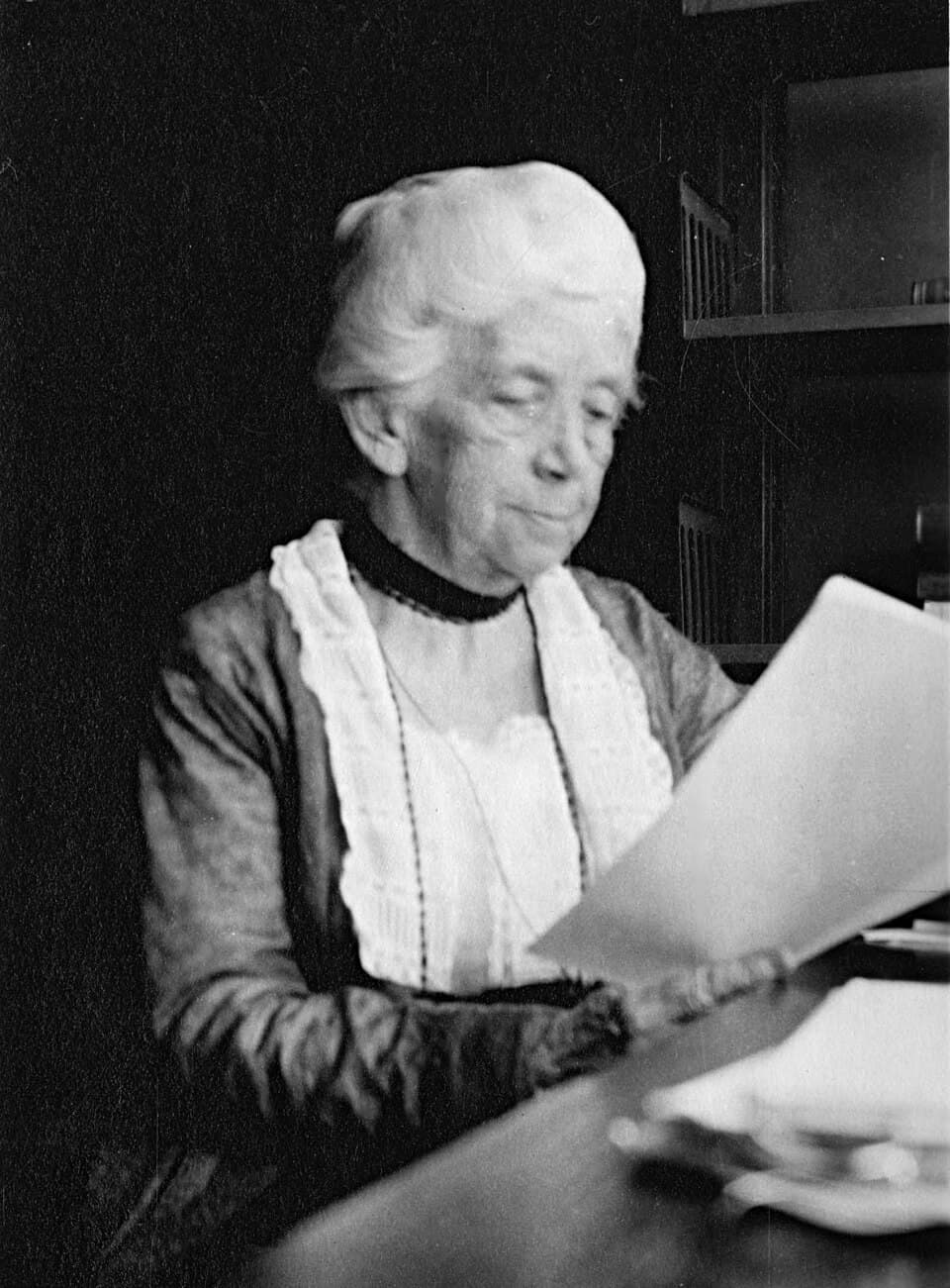
Christine Ladd-Franklin was born on December 1, 1847, in Windsor, Connecticut. Her father was a merchant. Her mother died when Christine was still young. Christine grew up with her brothers and sisters in a family that cared about learning. But back then, most people thought girls should not study hard subjects like math.
Christine loved puzzles and math from the time she was little. Sometimes she used a fake name so people would not know she was a girl. This helped her puzzle answers get accepted fairly.
In 1866, Christine went to Vassar College, a school for women. She studied math and science and graduated with honors in 1869. After that, she wanted to keep studying. But most colleges would not let women take advanced classes.
In 1872, Christine started studying at Johns Hopkins University. The school did not usually allow women, so they listed her name as "C. Ladd" to hide that she was female. She studied a kind of math called symbolic logic, which uses symbols to show how ideas connect.
By 1876, Christine had finished all the work needed for a Ph.D., which is the highest college degree. She even wrote a paper called "The Algebra of Logic." But the university would not give her the degree because she was a woman. This was very unfair.
Christine kept working hard anyway. She published math papers in a journal called Analyst. She became the first woman to do this. She also began studying how people see color and shapes. This is called vision science.
In 1886, Christine married a man named Fabian Franklin. She added his last name to hers. In 1887, Vassar gave her a special honorary degree. That same year, she published a paper about how our eyes see things. It was the first psychology research paper published by an American woman.
Christine later taught logic and psychology at Johns Hopkins, but she was not given a real professor title. She also taught for many years at Columbia University without pay.
Christine's biggest scientific idea was about color vision. She said that over time, animals' eyes evolved to see more colors, starting with just light and dark. She believed the newest parts of our color vision are the easiest to lose, which explains why some people are color blind.
In 1892, she shared her color vision ideas at a big science meeting in London. She kept writing about her theory for many years. In 1929, she published a big book called "Colour and Colour Theories."
Finally, in 1926—fifty years after she earned it—Johns Hopkins gave Christine her Ph.D. She was the first American woman to officially earn one in mathematics.
Christine was also one of the first women allowed into important science clubs, like the American Academy of Arts and Sciences. She spoke out often about how unfair it was that women were not treated equally in schools and science.
Christine Ladd-Franklin died on March 5, 1930, in New York City. She was 82 years old. Today, people remember her as a brave woman who helped make big discoveries in math and science, even when the world tried to stop her because she was a woman.